Index of/wp-content/uploads/ Movies Mkv | Mp4 Adult Content
How can teachers assist young children acquire expected behaviors?
Page 4: Teaching Classroom Rules
 Developing and displaying rules is an important first pace for helping children understand what is expected of them in the classroom. However, if children are to learn the rules and follow them every day in a multifariousness of settings, teachers must intentionally and systematically teach both the rules and the expected behaviors. Teachers tin do this by defining the rules, involving children in the process, reviewing them with the children, and providing additional supports if needed.
x
intentionally and systematically teach
The act of beingness thoughtful and purposeful about designing activities and providing didactics, and doing so in a methodical mode.
Clearly Defining the Rules
- Ascertain the rules using articulate, child-friendly linguistic communication (i.e., simple, physical; "We clean upward" instead of "We clean up after we make messes with paint and glue").
- Provide examples and not-examples when defining the rules to ensure that children sympathise them. For example, during group time the instructor might ask the children to role-play using "within voices" and "exterior voices."
Involving Children
- Involve children in discussions about the rules and why they are important. A teacher might enquire, "Why do you think information technology is of import to go down the slide anxiety-starting time?" Sometimes, children won't agree with or understand the purpose of the classroom rules; for this reason, it is important to discuss why these rules are in place.
- Apply diverse methods to teach children the rules. This includes discussions, role-plays, puppets, books, songs, and technology. A teacher might organize a small-group activeness in which two puppets deed out a non-instance of a dominion (e.g., running instead of using walking anxiety) and ask children to identify the rule that is not beingness followed, and so give examples of alternative means to carry. A instructor could likewise assist children identify whether rules are being followed in a story that is read to the class. A instructor can testify short videos related to the rules on a tablet and have children respond to them.
- Have the children contribute to a classroom rules book in which each dominion is demonstrated (in the form of a photograph) by children in the classroom. To personalize the volume, the children tin write their names beneath their pictures. Click hither for an example of a classroom rules volume.
"Our Classroom Rules Book" is a virtual "flip book." Clicking on the correct or left border of a page will move you forwards or backwards in the book.
(At that place are 5 double-pages in the book.)
The book begins with the forepart cover titled "Our Classroom Rules."
Turning to the first page it begins with the rule "Heed when others talk" underneath this classroom dominion is two pictures of children following this dominion. The first picture is of the whole class during circle time looking at the teacher and listening intently. The second moving picture is of Hudson and Jeremiah playing together as Hudson is listening to Jeremiah.
Turning to the second page yous run into the side by side classroom rule "Use kind words and gentle touches" underneath this rule is two pictures of children following this rule. The first movie is of Brynlee and Violet sitting and talking together outside on the playground. The 2nd movie is of a small group of children giving a gentle grouping hug.
Turning to the third folio yous see the side by side classroom dominion "Follow directions" underneath this rule is two pictures of children following the rule. The first motion-picture show is of the children following the direction to independently work on an art activity, the instructor is watching from her desk. The 2d flick is of Kennedy and Patrick cleaning upwards toys.
Turning to the fourth page y'all come across the adjacent classroom rule "Use inside voices in school" underneath this rule is two pictures of children demonstrating the rule. The first pic is of Kayden and Micah bringing their index finger to their lips and saying "shh." The second picture is Piper doing the aforementioned.
Turning to the fifth page you see the next classroom dominion "Use walking anxiety" underneath this rule is two pictures of children post-obit the rule. The first picture is of a group of students walking into the schoolhouse. The second picture is of Ariel walking.
(Close this panel)
Reviewing and Checking Often
- Review classroom rules daily during large-group times. This provides children with regular reminders almost the rules and helps ensure that adults are consistent in how they talk about rules and behaviors.
- Cheque periodically to see whether children sympathize the rules. This can be done through many of the activities listed to a higher place. For example, if the teacher is using a puppet to demonstrate inappropriate behavior, and the child cannot identify the dominion the puppet should exist post-obit, this is a signal that he or she may demand additional instruction.
- Use scripted stories to assistance children in understanding rules. Teachers tin also use scripted stories to address an individual child'south challenging behaviors. These can be created in hard copy or electronic format using a tablet or computer.
x
scripted stories
Short books written from a child'due south perspective that are used to teach children how they are expected to behave in different situations or settings. In most cases, particularly for immature children, scripted stories are illustrated with drawings, photographs, or clip fine art. The length of the story, the blazon of visuals used, and the amount of text per folio are dependent on the developmental needs of the private child.
A scripted story is presented in book course with illustrations and minimal text on each page. In this example, only the text for each folio is provided. In an actual book, illustrations would back-trail each folio.
Bennett Can Follow Directions (cover folio)
Page 1: My proper name is Bennett. I go to pre-thousand, and my teachers are Mrs. White and Mrs. Ryan.
Page ii: I practise a lot of fun things at pre-k, similar take grouping fourth dimension, go to centers, and play outside.
Page 3: At pre-k, we have to follow our classroom rules.
Page 4: I tin can follow these rules:
I tin listen when others talk.
I can utilize walking feet.
I can apply an inside phonation in the school.
I can use kind words and gentle touches.Page 5: The last rule is to follow directions . That rule is hard! It can mean a lot of unlike things:
Page 6: When I arrive in my classroom in the morning, I have to follow a lot of directions! Beginning, I sit down on my spot on the rug. When my name is called, I put my folder in the basket by the door. Then I walk to the cubbies. If I have a glaze on, I put my coat and my backpack in my cubby. Then I sit on the rug.
Page 7: At grouping time, following directions means I should sit crisscross on my spot. I should keep my hands to myself. If I want to talk, I should raise my mitt. I should look at Mrs. White and listen to what she says. When I follow directions at group fourth dimension, I take fun singing, dancing, and learning!
Page 8: I have to follow directions at centers, too! I tin play at the center if there is a Velcro spot open on the board. When I follow directions at centers, I have fun learning and playing!
Page 9: Even though it can be hard, I have to remember to follow the rules and follow directions. When I follow the rules and directions, school is more than fun!
In the first video below, the teacher involves children in reviewing the rules and in demonstrating examples and non-examples. In the second, the teacher uses a large-grouping activity to evaluate children's understanding of the rules.
Transcript: Reviewing the Rules
Teacher: Okay, let'south practice our classroom rules. Are you guys set up?
Children: Yes.
Teacher: Okay, I need some helpers. Let me see. Sean, what'south our offset classroom rule?
Sean: Walking feet.
Teacher: We employ walking feet. Show me walking feet. Prove me running. Where can you run?
Children: Outside.
Teacher: Outside. Good job. Deanna, what's another classroom rule?
Deanna: Inside voices.
Instructor: Inside voices. Say "hello" really, really loud.
Children: Hello!
Instructor: Where can you lot employ that voice?
Children: Outside.
Instructor: Exterior. Say "hello" using your within voice.
Children: Hello.
Teacher: Say "how-do-you-do" and don't brand a sound.
Children: Hello.
Teacher: Deja, what's another classroom rule?
Deja: Use gentle touches.
Teacher: Gentle touches. What would be a gentle touch?
Child: This volition.
Teacher: A pat on the dorsum, very good. How well-nigh a shaking of hands? Say "good morning time."
Children: Expert morning.
Teacher: Proficient morning. Or a hug. That's right. Good job or hold hands. Let'south say our rule together. Haley, volition yous point? Okay, betoken to them equally we say them. At the very top. Let's say them together.
Teacher and children: We use walking feet. We have within voices. Nosotros use gentle touches. We take turns, and we clean up.
Transcript: Evaluating Children's Understanding of the Rules
Instructor: I take a moving picture of a friend who's running in the classroom, using his anxiety for running.
Kid: Utilize feet for walking.
Teacher: Guys, is that a finish…
Child: Cease.
Teacher: …or is that a become?
Children: A stop.
Teacher: Information technology's a stop. Can you show me your red side?
Children: Finish.
Teacher: That's a stop. I run into some ruby-red. Very good. That'south a terminate. I have a friend, and you know what? They want to get through, and so what he does is he kicks his friend'southward leg out of the way. Is kicking a go, or is kicking a stop?
Children: It's a stop.
Teacher: Kicking is a end. We employ our feet for…
Children: Walking.
Teacher: Walking. What are "go" things, and what are…
Children: Stop things.
Teacher: …what are "stop" things? Now I have 1 other affair…
Providing Individualized Back up
In improver to the more than-universal strategies for educational activity rules (described to a higher place), teachers might need to provide some children with more individualized instruction and support, such every bit:
- Additional one-on-one instruction and reminders about the rules
-
Copies of the visual supports to serve as cues and reminders of the rules. Sometimes, information technology is helpful for the teacher to have a small-scale, portable visual (due east.g., fundamental ring, a lanyard, modest board) that she can pull out to remind the child of the rules when in different locations. Alternately, the teacher can provide the kid with a copy of the visual to acquit.
Credit
The Picture Communications Symbols ⓒ1981-2014 by Mayer-Johnson LLC. All Rights Reserved Worldwide. Used with permission.
- More specific definitions and visuals to help children sympathise what it means to comply with the rules.
For a kid who had difficulties using gentle touches, the teacher created additional visuals that showed dissimilar types.
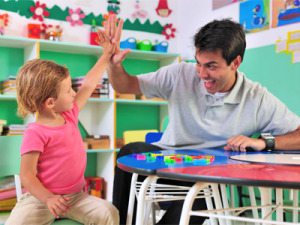
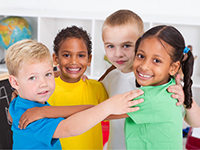
(gentle touches tin exist high-fives, a pat on the back, holding hands, hugs)
Hug
(but ask 1st)
For Your Data
Teachers must consider each kid'due south needs and abilities when teaching the classroom rules. Examples include:
- For a child who has a visual damage, a instructor might make the visual larger or provide objects for the child to manipulate.
- For a child who has a receptive language delay, the teacher might utilise short, simple language (e.yard., "Overnice walking, Kelly!" instead of "Kelly, I noticed y'all used your walking feet in the hallway.")
Amanda Peirick and Mary Louise Hemmeter offer more information well-nigh education classroom rules.

Amanda Peirick, MEd
Lead Teacher, Susan Gray School
Nashville, TN
Systematically teaching rules (fourth dimension: three:xxx)

ML Hemmeter, PhD
Professor, Special Education
Co-Faculty Manager of the Susan Grey School for Children
Vanderbilt University
Systematically didactics rules (time: 2:15)
Transcript: Amanda Peirick, MEd
I retrieve that reviewing and going over them daily is very of import. When I was a immature teacher, I kind of made the mistake of "I taught my rules! Now let's go." And then a few months into the year, I'm, similar, "Where'southward all this beliefs coming from?" Then I learned subsequently awhile that to keep these at the front of our heed and for kids to actually empathise what they are, that we accept to go over them over and over and over over again and sometimes you lot start to feel, similar, "I accept said this iv,000 times. How do they not know this at this point?" But then you lot realize when you stop giving those reminders, that it'due south just not something they're thinking about on a regular basis. And then reviewing them daily from the day you outset school till the cease of the yr is really important for these kids. In pre-K nosotros teach our letters, our numbers, our shapes, our colors, and nosotros do information technology very systematically because these are things that kids need to know. Nosotros need to teach behavior just as systematically. A lot of times, nosotros simply think kids empathise, they empathise what they're supposed to exercise. Everybody knows you come to circle time and yous sit, and you're supposed to listen to your teacher. But what we found is that kids don't always know, and that's when we outset to see the challenging behaviors. We need to be really systematic nigh didactics these things also.
Education these rules and expectations is just as important equally education the academic skills. I similar to think about it in the same way and then that I take a way that I introduce these skills in large-group activities that everybody is kind of learning what the behaviors are. And so nosotros give kids chances to practice post-obit the rules or what the rules wait like or knowing what these rules are throughout the mean solar day. Then we can motility on to supporting them, maintaining and generalizing these behaviors. Some ways that we do that, allow'south meet, we take lots of large-group games that we develop about what should our classroom rules be. Nosotros desire to involve kids in developing these.
As a teacher, we definitely display our self every bit an potency figure, but we desire to get their buy-in and so we desire to talk with them about why are we having these rules and what makes it important? In my class, nosotros do a lot of role-playing around behavior expectations. I've started to use puppets lately, which I call up is really engaging for the kids. We play out different scenarios of our beliefs and what happens when we're using things that are rules and aren't rules. Nosotros accept developed a social story in my class that we kind of use to introduce the rules. And in the story, we put pictures of the kids post-obit each rule. So this is what it looks like when we're using our walking feet. This is what it looks like when we're using our gentle touches. This is what it looks like when nosotros're using nice words. That goes in the book center and they get to read it throughout the 24-hour interval, and they dear seeing pictures of themselves following the rules. We created a rule vocal in our classroom. Music is a really engaging way to teach new things to kids sometimes and then to exist able to review it over and over again. We developed a song that we sing every day in circle fourth dimension that goes over what each rule expectation is so that they can accept that reminder on a daily basis. Nosotros also similar to practice a lot of examples and non-examples of what the rules are. Those are some sort of structured things that we do. It's actually important throughout the day to exist recognizing these things when they're happening, both when the kids are participating and following the rules, but and then also if you lot see a kid who's not using a rule to be able to go and have a conversation about that. Remember we use our gentle touches. Why is it important to use our gentle touches, and what happens when we don't, kind of, throughout the day on an ongoing basis.
Transcript: ML Hemmeter, PhD
One affair nigh rules and expectations is that frequently teachers develop rules and expectations simply aren't systematic in how they teach children the rules and expectations. And and so in that location are squeamish posters, and we talk nigh them for a few weeks at the beginning of the year. What we know is that it takes time for children to learn anything, and just like it takes them fourth dimension to learn how to read or write or talk or walk, it's going to take them fourth dimension to learn what the expectations are. And so, I think, ofttimes when children aren't engaging in expectations in classrooms, it's because nosotros haven't been systematic about how nosotros teach them. When nosotros're systematic near how nosotros teach them and three-fourths of the classroom is now doing them and a fourth isn't, often we think if we just keep teaching it in the same mode they'll larn. And oftentimes the children who are engaging in problem behaviors, who aren't engaging in the expectations, are children who are going to need more individualized instruction effectually that expectation, who are going to demand more practice with the expectations, who are going to need more feedback near the expectations. And often nosotros view those children as having challenging behaviors when we really haven't been systematic enough about teaching them what to do in place of the trouble behavior. It will be important when you're teaching rules and expectations to call back not simply nigh how you're teaching those to the whole class merely how you're teaching them to private children and realizing that what you do for the whole grade is probably not going to exist enough for some children, and that you may demand to recollect about more individualized ways of teaching the rules and expectations to children who have more severe problem behavior. But that doesn't hateful that those are children who need something beyond that individualized pedagogy. That might simply hateful more than teaching, might mean more than-frequent instruction, might be mean more than-systematic instruction, more-intense teaching to really aid them acquire the routines and expectations of the classroom.
Visual supports (fourth dimension: 4:03)
Scripted stories (time: 2:06)
Transcript: Amanda Peirick, MEd
Visuals are one of the about amazing education tools in the world. I retrieve for a lot of reasons they're essential to instruction lots of skills and especially rules and expectations. One of the reasons is that it'due south really helpful for kids processing information. We utilize a lot of words throughout the day, and we know that kids are only processing a small pct of what nosotros're saying when they're three, four, and five years one-time. It's really important for them to have that visual that'due south constant, that tin assistance remind them and assistance them understand what our words mean. At that place's this interesting phenomenon that yous can't argue with a visual. Sometimes, if a teacher is giving a direction, information technology's really like shooting fish in a barrel for a child to want to do something different, simply if information technology's a visual the visual is constant. It can't modify what it'due south asking you to do, and it's ever going to be in that location. I think that's comforting for kids: "I know what this means and I sympathise it, and I tin can follow that dominion." It'due south also really helpful to utilize visuals to be able to redirect beliefs without stopping what you lot're doing. A lot of times, y'all're didactics a actually great activeness, and if y'all take to stop and give a rule reminder, it stops the menstruation. The other kids are not able to attend equally much anymore. But if y'all have visuals handy, you tin can just show a visual. A lot of times, that's all a kid needs. You tin can keep doing what you are doing and keep existence able to teach and moving forward with the activeness that you were participating in.
In my classroom, we have a large poster of our school-broad expectations, and each expectation has the words and a visual of what that expectation is, and and so we too have a page of each classroom rule, also. We have iv classroom rules that we use, and each rule has its own poster in the classroom. Those are posted at our circumvolve fourth dimension area, which is too our block center. It's visual throughout the day. Kids tin can become over there and refer to them if they need it. We take created some more than-specific rules for activities. Nosotros have some rules for circle time that help children know what's the best way I tin be a listener or a learner during circle time, what kind of a voice do I use, what do my legs need to look like? Those things we proceed on Velcro strips around the room, so that they're easily accessible all the time, and the teachers can just pull them off and use them every bit a reminder. One affair that we've besides institute really helpful is that we did a small group where our kids were able to depict pictures of themselves following the rules. So on our rules visuals around the classroom, the kids take participated in making those and in that location are pictures that they have drawn, and they wrote their names on the rules, besides. So I retrieve that what we found is that when you have these things in place, we run into a really big decrease in a lot of challenging behavior in the classroom.
There are yet some kids that these rules are not meaningful, and they're still not understanding what these concepts are. There's a lot of different things that that we can do around that, but information technology goes on a child-by-child basis. If the kid is having a hard time following a rule or having some challenging behavior, we starting time try and recall about why. What is this child communicating to me by this beliefs by not beingness able to follow the rule? And so we can develop a plan for what do your individuals visuals need to look like. Sometimes, kids don't understand. The visuals in my classroom are usually line drawings. I start with that. Sometimes then we'll take pictures and put them in classroom book. Some kids don't understand what the line drawings mean. If I find that a child is not really following the rules, I'll have pictures of that child following the rules throughout the mean solar day and put that in a social story or a book or even a keychain that they can take on them at all times that you tin just refer to. "Oh, remember, we have to utilise our walking feet at present." That'southward been helpful throughout the twenty-four hour period. It might be helpful to have some organization where these children are working for some reward for post-obit the rules. They might need a little extra back up and understanding what this dominion is and being taught how to really practise information technology in the classroom. Sometimes it can exist, "Hey, yous're working to use your nice hands throughout the 24-hour interval today. Every time I see you using your overnice hands, mayhap we become a sticker on a chart or possibly we get something special that'south really going to help you understand what information technology looks like when you're doing this rule and that makes it meaningful to y'all."
Transcript: ML Hemmeter, PhD
We use scripted stories equally a way to teach children the concepts around appropriate behavior, around routines, or around expectations. You can use scripted stories that you write for the whole classroom that introduces what the expectations are of the classroom, but does information technology through a story and uses visuals. The visuals can be the same visuals that are in the classroom to aid remind children about the rules and expectations. We besides often employ scripted stories to teach individual children who are having difficulty with either an expectation or a dominion, or difficulty with the routine in the classroom, more-appropriate ways to engage in that routine or those expectations. I of the benefits of doing that with individual children is that you tin use visuals that are actually the kid engaging in the routine, and so just making the scripted story is an opportunity to prompt the child through the routine. Then the pictures in the book are the child actually engaging in the routine. Scripted stories can be used for a whole lot of things, like helping children sympathise arrival in the classroom or leaving the classroom, or what to do in circle time, or how you're prissy to your friends, whatsoever of those kinds of things. Merely it's also important to realize that scripted stories are just a tool for introducing those concepts to children, and that using the scripted story in the absenteeism of good prompting and scaffolding and reinforcing in the actual context is probably not going to be constructive. For scripted stories to be most effective, that'south the way yous introduce it to the child. That'south the way you remind the kid of what the expectations are or the routine is, then actually helping the kid practice what's in that scripted story in the existent activity or routine that they demand to use it will be of import to really didactics the child how to do it.
Revisit Mrs. Rodriguez's Classroom
 Mrs. Rodriguez realizes that merely displaying the new rules won't be plenty to get her children to follow them. Instead, she is going to have to teach the rules just as she had taught every other concept all year, intentionally and systematically.
With that in mind, Mrs. Rodriguez examines her schedule and pencils in a fourth dimension each day to talk virtually classroom rules. During this time, she offers a variety of activities, such as part-plays, puppet shows, and think-pair-share, to help her children better empathize the rules. During each activeness, they talk over examples of following the classroom rules and examples of non following the classroom rules. Jerry is especially excited nigh the opportunity to demonstrate examples of non post-obit the rules.
x
think-pair-share
Learning strategy that provides children time and construction to call back almost a given topic or question, pair with a peer and share their own ideas with their partner, then share their ideas with classmates.

Source: https://iris.peabody.vanderbilt.edu/module/ecbm/cresource/q1/p04/

Post a Comment for "Index of/wp-content/uploads/ Movies Mkv | Mp4 Adult Content"